Wave of Light + Revolution
Dear friends,
Several of my patients have told me something similar this month: this season feels like an exquisitely painful convergence of everything they carry. October asks us to remember and honor so much at once.
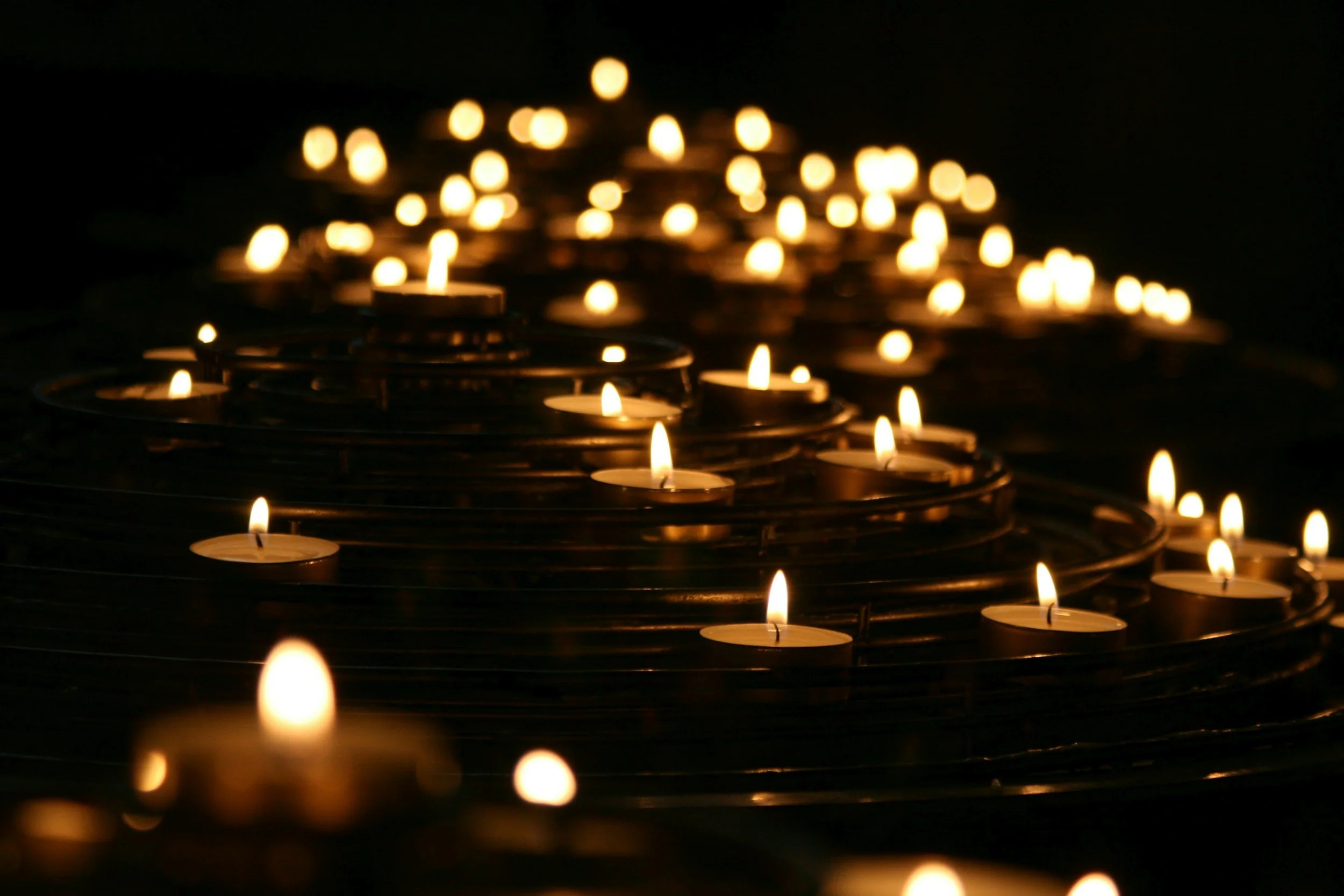
It is Pregnancy and Infant Loss Remembrance Month, a global tribute marked by memorial walks and candlelight vigils. Tomorrow, October 15 at 7:00 p.m. local time, people around the world will light a candle for the Wave of Light and let it burn for at least an hour. As the time zones turn, those small flames become a continuous, 24-hour wave circling the globe in memory of babies lost too soon.
It is also Domestic Violence Awareness Month, a time for raising voices and resources against abuse in the place that is supposed to be safest.
Read that slowly and you can feel the weight of it. It is a catalog of losses and experiences no one expects or prepares for. And yet we live them. We survive them, somehow, and we keep going. People are remarkable that way, and women in particular. Every day I witness the strength and daring of women: a survival skill baked in deep, a fierce determination to keep going for ourselves, for our children, and maybe, a little, because we refuse to miss whatever comes next.
There is a flip side, and we are grappling with it as a culture: the profound vulnerability of women’s bodies. The body keeps its own ledger. The wrist broken on roller skates that still aches when it rains. The IUD insertion, the pelvic exam, the long hours of laboring with our babies. We remember all of it. This month in particular, alongside the unthinkable headlines out of Cornell, many women are finding memories of unwanted sexual experiences back in full color, and packing a punch. Traumatic memory isn’t filed away like a story with a beginning, middle, and end. It’s stored in fragments, stitched to the senses (a smell, the sight of a hospital, a certain slant of afternoon light), and it can return whole and uninvited. We see through a glass darkly, and sometimes it takes someone with a little distance, a therapist, a nurse, a friend, to help us piece it together.
Jane Doe’s story is a painful example of this right now. I know many of you are watching it unfold feeling gutted and enraged. The suffering of women, even now, can feel endless. I have yet to meet anyone left untouched by this cultural moment. It can look as if cruelty, misogyny, and bad behavior in all its forms are winning the day.
So let’s fight, let’s work, and let’s use our voices until that is no longer true.
I want to offer something else that may sound, at first, too small for a moment this heavy. I’ve been wanting to write this for a long time: I believe female joy is the medicine we need, the difference between surviving and actually living. I’m proposing that female joy is the revolution this moment calls for, and I don’t mean that to be trite, or glib.
Women have long been measured by what we can endure: how much we can carry, absorb, smooth over, and quietly survive. We are praised for our resilience and then handed more to be resilient about. Joy refuses that bargain. It insists that a woman’s life is meant to be lived, not merely withstood. When the forces around us would prefer us small, exhausted, frightened, and estranged from our own bodies, a woman who delights in being alive is quietly ungovernable.
Audre Lorde, writing through her own illness, put it plainly: “Caring for myself is not self-indulgence, it is self-preservation, and that is an act of political warfare.” Elsewhere she wrote about the erotic, not only sex but the deep, felt yes of being fully alive, as a source of power women have been taught to distrust. I think she was right on both counts.
Joy is also sound clinical wisdom. A nervous system that has lived through harm learns to watch for danger; that’s its job, and it does it faithfully. But healing doesn’t come from vigilance alone. The body also needs evidence of safety, gathered slowly and repeatedly, and delight is some of the most persuasive evidence there is. Laughter, play, pleasure, a hand on your back: this is how the body learns it can come down off high alert. Every moment of real joy is a small act of repair. It reminds the body that yes, it has been a site of harm, and it is also a home.
This is not a call to be positive. Joy doesn’t cancel grief, and it was never meant to. On October 15, many of you will light a candle for a baby you carried. Some of you are mid-IVF, or mid-leaving, or in the middle of something no one else can see. The poet Ross Gay suggests that joy and sorrow aren’t opposites at all, that joy is often what rises up when we help each other carry what hurts. Grief and joy sit at the same table. Often they are holding hands under it.
So what does female joy look like in a life? A few invitations:
Reclaim your body as a place of pleasure and peace. After medical traumas, sexual trespasses, violence, births, losses, and exams, the body can start to feel like a medical chart, or a crime scene. But it is also where every good feeling you have ever had has lived. Move with intention, or be still with intention. Shape the space you need to thrive and fill it with what soothes you. Have sex you actually want, on your terms. Pleasure is not a reward you earn once the suffering is over. It’s yours now.
Enjoy life with your people. The group chat. The friend who makes you snort-laugh in all the wrong places. Women falling into helpless hilarity together has always been a little subversive; there’s a reason the quilting bee and the book club have outlasted empires. Laughter discharges what the body has been holding. Find your people and be ridiculous together.
Make something beautiful, for yourself or in memory of someone. Bake a cake for no occasion. Put grocery-store flowers on your own table. Plant bulbs this fall that won’t bloom until spring, an act of faith you can hold in your hand. If you are grieving, let your hands do some of the remembering: knit the blanket, frame the ultrasound photo, plant the tree, write the letter you’ll never send. Beauty made for its own sake is a quiet declaration that you are more than what you produce, and beauty made in memoriam says that a life, however brief, mattered.
Say yes to the dreams you shelved. The trip, the degree, the tattoo, the business, the guitar in the back of the closet. So many women keep a list of dreams politely set aside until things calm down, until the kids are older, until there is more money or more time or more permission. Pick one and take a single step toward it this month. You don’t need to justify wanting things. Wanting is its own kind of aliveness.
Be subversive: heal out loud. So much of what happens to women is meant to stay quiet: the miscarriage no one mentions, the birth that went wrong, the night we don’t talk about, the diagnosis we keep to ourselves so no one worries. Silence has been asked of us for generations, and it has never once protected us. Healing out loud is the opposite. Say the name of the baby you lost. Tell a friend the true version, not the tidy one. Let yourself cry where people can see. And then let your joy be just as visible: laugh loudly in public, wear the thing you were told you were too old, too big, or too much for, rest without explaining yourself, say no without a paragraph of apology after it. Each time one of us speaks plainly about what hurt and what helped, another woman learns she isn’t alone. A woman at ease in herself, unashamed of her scars and her delight, has always been a little dangerous to a culture that profits from her silence. Be dangerous.
Tend your joy like a flame. Shelter it, feed it, and don’t wait for it to nearly go out before you notice it’s dimming. Centering your joy and prioritizing your living isn’t selfish. People who regularly replenish their emotional reserves are better able to stay present and keep showing up for what matters. You’re allowed to log off. Constant exposure to distressing news keeps the body in a low hum of threat, but you can stay informed and engaged without letting the news cycle colonize every waking hour. Choose when you take it in, then close the tab. Guard the moments that fill you back up, like the quiet coffee, the friends and family who feels like home, or the walk with no destination, and say no to whatever drains them dry. Every boundary you set around your joy is a way of saying your life is worth tending, too.
Celebrate other women’s joy, and do it out loud. Cheer for your friend’s new job, her raise, her daring idea. Joy multiplies when we stop measuring ourselves against each other, and the girls and young women around us are watching how we treat our own happiness and each other’s. But celebration means more when it’s rooted in understanding. Get educated about the systems of oppression we face right now: how sexism intersects with racism, classism, ableism, and transphobia to shape whose pain is believed, whose bodies are protected, and whose joy is treated as excessive. These systems don’t affect all women equally, and solidarity begins with being honest about that difference. Listen to women whose lives look different from yours and follow their lead. For many, survival itself is an achievement, and finding delight amid hardship is an act of defiance worth honoring. Stand with all women, for their right to safety, dignity, rest, and joy, not just their right to endure. Know, and understand, so you can be part of the repair, because a revolution of joy only matters if every woman is invited in.
Let joy and grief share the room. We often assume they can’t coexist, that feeling good means betraying the loss, or that honoring the loss means closing ourselves off to anything else. But the mind doesn’t work in neat either/or terms. Psychologists who study bereavement describe healthy grieving as an oscillation: we move toward the pain, then away from it, then back again. Turning toward the loss lets us feel it and make meaning from it. Turning toward life lets us rest, recover, and remember that we are still here.
I keep coming back to that wave of light on October 15th: candles lit hour after hour as the earth turns, so that for one full day the dark is never entirely dark. That is what women have always done for one another. We keep the light going. We hold it for each other when we can’t hold it for ourselves.
As women, we have always known in our bones that the personal is political. The revolution doesn’t only happen in the streets though go, if you can, and be ready to vote on November 3rd. It happens in a kitchen full of friends and family. In a mother who lets herself rest without apology. In a survivor who dances freely at her own birthday party. In every one of us who has seen the worst of what can happen to a woman’s body and still chooses, stubbornly and gloriously, to delight in being alive. No one can legislate that away. No one can take it from us, at least not permaently.
So this month, alongside the candles and the ribbons and the hard, holy remembering, let yourself have something sweet. Female joy is the revolution. Go start one.
There are sexual abuse resources listed below.
There is also a link to a store with comfy clothes for the revolution! 10% of October sales will be donated to support the critical work of Women Against Abuse: https://www.womenagainstabuse.org/
Take heart, dear you. We’re in this together.

PA sexual assault resources:
Immediate support
PCAR statewide hotline (24/7): 1-888-772-7227, or you can find your local rape crisis center directly at pcar.org. The organization now goes by the Pennsylvania Coalition to Advance Respect. The hotline connects callers to a network of 47 rape crisis centers serving all 67 counties. pcar.org +2
Local rape crisis centers: These offer free, confidential crisis counseling around the clock (with some exceptions due to mandated reporting), services for family, friends and partners, and referrals. Advocates can go with survivors to the hospital, police station and court, and can help with legal processes like protection orders. pcarpcar
Emergency: Call 911 if you’re in danger.
Victims Compensation Assistance Program (VCAP), the state crime victims fund
Run by the PA Commission on Crime and Delinquency. Call 717-783-5153 or toll-free 800-233-2339, or go to pcv.pccd.pa.gov. pa
Other state resources
PA Office of the Victim Advocate: 800-563-6399 pa
Address Confidentiality Program, which keeps your address private if you relocate: 866-972-7284 pa
ChildLine, for abuse involving a minor: 1-800-932-0313 pcar
Domestic violence situations: PCADV.org/find-help, or the National Domestic Violence Hotline at 1-800-799-7233 (text LOVEIS to 22522) lackawannacounty
National Sexual Violence Resource Center: 877-739-3895 pa
RAINN national hotline (24/7): 800-656-4673, with online chat at rainn.org