250 Years In: Are Women Actually Included in the Experiment?
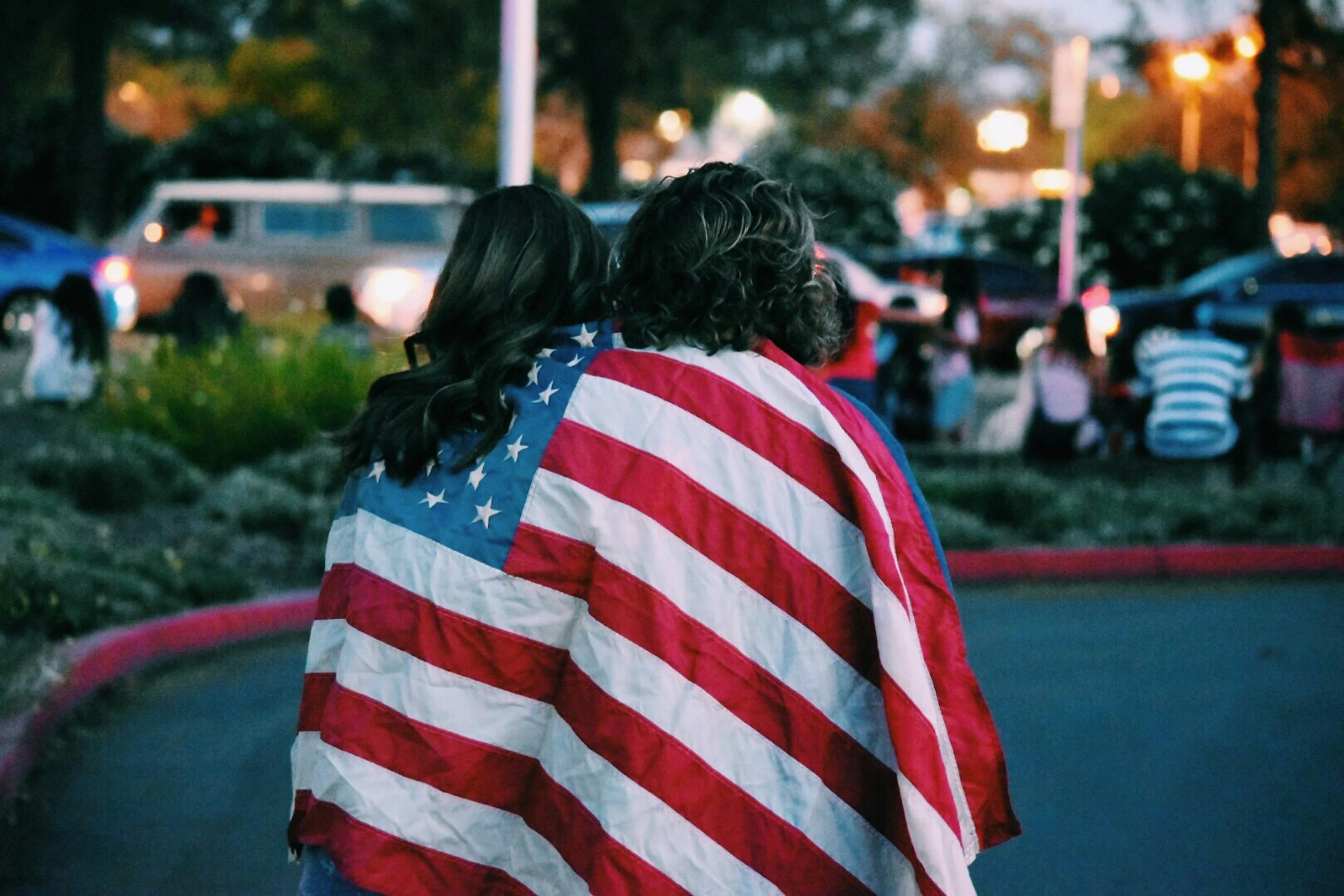
the backs of two women draped in the american flag
Dear friends,
Two hundred fifty years ago, a group of men signed their names to an idea: that a nation could be built, tested, and revised in real time. They called it an experiment because they didn't know if it would work. They also didn't ask half the population if they wanted in.
A month past the actual anniversary, this felt like the right moment to ask: how's the experiment going for women, not the founding-myth version, the actual one. Wages, healthcare, representation, the quiet accumulation of laws and norms that shape whether a woman's citizenship feels full or partial. That question matters a great deal right now, because the loudest thing said about American women this year has been about how many babies they should be having.
This season we've been awash in pronatalist messaging, encouraging women of America to have more babies. This seeming national priority has been taken up by the likes of influencer Erica Kirk, who told a graduating class to "have more babies than you can afford." Dr. Oz says America is "underbabied." Donald Trump has said he'll be known as "the fertilization president." JD Vance says he wants "more babies in the United States of America." On its face, this looks like a nation that loves babies and supports women and families after birth. It couldn't be further from the truth. Our national statistics around medical access, maternal mortality, paid family leave, and affordable childcare are abysmal. These messages could not be more tone-deaf for a nation ranked last in many categories of maternal health.
"Have more babies than you can afford" might as well be restated as:
"Tie cinder blocks to both of your ankles, and jump in a river.""Prepare yourself for a lifetime of worry and stress that will impact your health.""Give up all your personal dreams outside of having children.""Prepare yourself to be in this partnered relationship for the foreseeable future. There will be no easy way out."
This may sound hyperbolic, but I'm being quite candid, because we do women a disservice when we keep our griefs private and our data separate. So this is an examination of both: what I'm seeing in the room, and what's actually happening in the country and the state we live in. I sit with women all day. Not just mothers, though that is the center of my work, but women navigating the long spectrum of female life: the ones deciding whether to become mothers at all given the current state of things, the ones grieving a pregnancy that required a merciful termination, the ones trying to scrape together enough time-off for a humane and sane maternity leave, and the ones white-knuckling through perimenopause while still packing lunches. I hear the interior of their lives in a way most people never get to. And lately, underneath the individual stories, I keep hearing the same undertow: women are exausted, drowning and losing faith in the people charged to protect and represent them.
On bodies. The U.S. has the highest maternal mortality rate of any wealthy nation on earth. We lose mothers at a rate closer to Chile than to Norway, despite spending more on healthcare than any country in the world. More than 80% of those deaths are considered preventable. It's not fate or biology; it's a system that stops scaffolding adequate support the moment the baby is born. Black women in this country die from pregnancy-related causes at more than three times the rate of white women, a gap born of unequal care and the cumulative weight of chronic stress on the body, what researchers call "weathering." Racism literally degrades the body and worsens maternal and fetal health outcomes.
On choice. If a woman or girl cannot control her reproduction, she cannot control her life. Since Dobbs, roughly 63 million women and girls now live under abortion bans or severe restrictions. A Johns Hopkins study of ban states found higher maternal death rates following the bans, tied to delayed miscarriage care and physicians frozen by fear of prosecution until a patient is already critically ill. Several of those same states have also quietly restricted their own maternal mortality review committees, the bodies whose entire job is to ask why mothers die. You cannot fix what you refuse to measure. I sit with women who are more afraid than ever to become pregnant, despite the fact that Pennsylvania has not changed its abortion laws. This fear is also not abstract to me or my patients as they travel around the country for work or pleasure as a pregnant person. The country is now a literal patchwork of protections and care, there is nothing cohesive.
On money and time. The U.S. earned an outright F this year on parental support, paid leave and childcare, on the national maternal health report card. Even the best state managed less than four out of five stars. Meanwhile, women still shoulder the bulk of unpaid caregiving and still take the hit to income and career trajectory known as the "motherhood penalty." Power, in this country, still runs partly on the ability to earn, to plan, and to not be financially undone by having a child. That ground is eroding too, and I am not hearing the alarm bells sound by enough observers.
On mental health. One in five mothers will face a maternal mental health condition, depression, anxiety, OCD, and 75% of them will get no treatment at all. It is the most common complication of childbirth in America, more common than diabetes or preeclampsia in pregnancy, and yet it is still the thing women apologize for bringing up. This suffering is not a footnote to someone else's story. A woman moving through untreated anxiety or postpartum depression is living inside that experience every hour of every day, and that alone is reason enough to take it seriously, regardless of what it does or doesn't affect downstream. Untreated mental health disorders can also directly impact outcomes for children. If we are a nation that says it cares about children, then more access to quality maternal health care is the clear answer, but it shouldn't have to be the reason we finally start caring about mothers too.
On Pennsylvania. I want to name something true and good here, because I don't want this to read as only despair. Abortion remains legal and accessible in our state. We also earned one of the only "B" grades in the country this year on maternal mental health care. That is not nothing. Access and support tend to travel together: where one holds, the other tends to hold too. It tells me something about what's possible when a place decides women's lives matter enough to protect. In December 2025, the Pennsylvania House of Representatives also passed a proposed constitutional amendment protecting reproductive rights, by a narrow 102–101 vote. (That was a legislative vote, not a public referendum. Pennsylvania constitutional amendments must pass the legislature in two consecutive sessions before going to voters, so this was only one step in the process.)
As I wrap up this brief this review, I have no tidy answers. Some months call for grief and clarity rather than resolution. What I know, from the enormous privilege of hearing so many women's real stories, is this: you are not imagining it. Something is being asked of women right now that is not being offered in return. And still, still, I watch women survive this, mother through this, grieve and rage and continue, with a strength that has no proper name. I don't think that strength should have to be the whole plan, but until the ground stops shifting, I want you to know someone is paying close attention. I am. We are here.
So here we are at mile marker 250 of the American experiment. This is not a finish line, but a place to stand and take honest stock before we keep walking. Pennsylvania has shown what's possible when a place chooses to protect women and hold the line. That work isn't finished, and it isn't automatic. It has to be tended, funded, voted for, and fought for, over and over, by people who refuse to let it slide backward. And nationally, the ground we're losing didn't disappear on its own; it will not return on its own either. Gaining it back, for women, for children, for the families who are stretched thinnest right now, is going to take all of us, together, for a long while yet. I intend to keep showing up for that work, in this office and beyond it. I hope you'll keep showing up too, in whatever way is yours to give.
Wherever you are in your story, pregnancy, postpartum, loss, a decision you're still sitting with, or just trying to feel like yourself again, you don't have to hold it alone.
References:
Commonwealth Fund, Insights into the U.S. Maternal Mortality Crisis: An International Comparison (2024) and Maternal Mortality in the United States, 2025 — data on U.S. maternal mortality rates compared with other wealthy nations, and preventability of deaths. commonwealthfund.org
CDC / Commonwealth Fund data on racial disparities in maternal mortality and "weathering" research on chronic stress and Black maternal health outcomes.
Bell, S. et al., "Abortion Bans and Maternal, Pregnancy-Related, and Pregnancy-Associated Mortality in 14 US States, 2016–2023," American Journal of Public Health, and Johns Hopkins Bloomberg School of Public Health coverage of the study (2026) — findings on increased pregnancy-associated mortality in abortion-ban states and care delays tied to legal uncertainty. publichealth.jhu.edu
Policy Center for Maternal Mental Health & George Washington University Milken Institute School of Public Health, 2026 Maternal Mental Health State Report Cards — national "F" grade on parental support (paid leave and childcare), state-by-state grades, and Pennsylvania's "B" rating. policycentermmh.org
Policy Center for Maternal Mental Health — statistics on maternal mental health conditions affecting one in five mothers and the 75% treatment gap.
Pennsylvania General Assembly, House Bill 1957 (2025–2026 Regular Session), and reporting from the PA House Democratic Caucus and local outlets on the December 2025 102–101 House vote on the Reproductive Rights Amendment. palegis.us